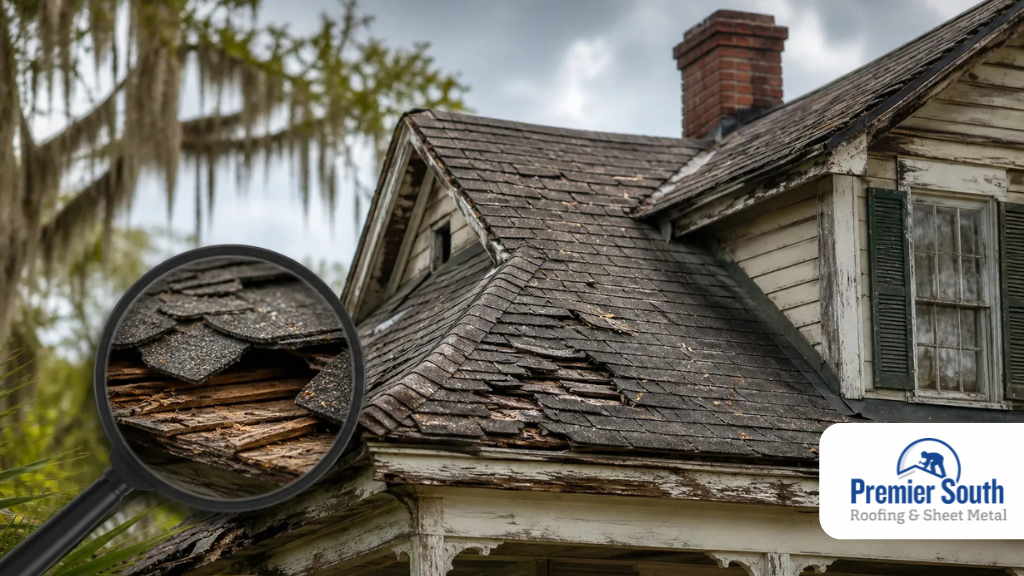
Louisiana’s combination of punishing heat, relentless humidity, tropical storms, and salt-laden coastal air creates one of the harshest roofing environments in North America. For homes built before the 2000s, and especially those predating Hurricane Katrina’s revised building codes, these conditions compound over decades into a list of roofing problems that go far beyond a few missing shingles. If your home is 20 or more years old, understanding what’s likely happening above your ceiling is the first step toward protecting your investment.
This guide walks through the most common roofing problems found in older Louisiana homes, covers critical structural inspections of rafters and decking, and explains the code upgrade requirements that often come into play during a re-roof project.
1. Aged and Deteriorating Shingles
The most visible sign of an aging roof is its shingles. Standard three-tab asphalt shingles from the 1980s and ’90s were rated for 20–25 years under ideal conditions, conditions that Louisiana simply doesn’t offer. Intense UV exposure accelerates granule loss, while repeated thermal cycling (extreme heat followed by overnight cooling) causes shingles to crack, curl, and cup.
In older homes you’ll typically see granule-filled gutters and downspouts, shingles that have lost their uniform texture, dark streaking caused by algae or moss growth, and cracked or missing shingles concentrated around ridges, hips, and valleys where heat and moisture accumulate most. It’s worth noting that how long a roof lasts in Louisiana’s climate is significantly shorter than the national average, often by five to ten years, precisely because of these environmental stressors.
Once granule loss passes a certain threshold, the asphalt mat beneath is exposed directly to sunlight and rain, and the roof’s waterproofing ability deteriorates rapidly. At that point, repairs become a game of diminishing returns.
2. Chronic Moisture Intrusion, Mold, and Wood Rot
Few roofing problems in the Deep South are as insidious as long-term moisture intrusion. Louisiana’s average annual humidity regularly exceeds 75%, and a roof system that is even slightly compromised, a cracked flashing, a failing pipe boot, a single lifted tab, can allow moisture to migrate into the attic space and begin saturating the wooden roof structure.
In older homes this is particularly dangerous because many were built without modern self-adhering underlayments. Felt paper, the underlayment standard for most of the 20th century, absorbs moisture and breaks down over time, leaving the decking with minimal secondary protection. By the time stains appear on interior ceilings, the problem has usually been developing for months or years.
Beyond structural damage, persistent roof leaks create prime conditions for mold colonization. If you’ve noticed musty odors in your attic or upper rooms, those are red flags that warrant immediate attention. Understanding the connection between roof leaks and mold is essential for Louisiana homeowners, because mold remediation after the fact is far more expensive than fixing the leak that caused it. Learning to spot the early signs of roof water damage before it escalates into a major repair can save thousands of dollars.
Pro Tip: In Louisiana’s climate, a small leak rarely stays small. The combination of heat and humidity means mold can begin growing on saturated wood within 24–48 hours of exposure. Don’t wait for a second rainstorm to confirm a suspected leak.
3. Structural Inspections: Rafters and Roof Decking
This is the section that separates a surface-level shingle replacement from a thorough, professional re-roofing project. In older Louisiana homes, the structural integrity of the roof system, specifically the rafters and decking beneath the shingles, must be assessed before new materials are ever installed. Covering damaged structure with fresh shingles doesn’t solve the problem; it buries it.
Roof Decking Inspection
Roof decking (also called sheathing) is the flat board layer, usually plywood or older board sheathing, that sits directly on top of the rafters and provides the nailing base for shingles. In Louisiana homes more than 30 years old, there are several common decking concerns:
Delamination of plywood panels. When moisture repeatedly saturates plywood decking, the glue layers between plies break down, causing the panel to separate. Soft spots underfoot during a roof walk are the telltale sign. Delaminated decking cannot hold nails properly, which means shingles installed over it are at serious risk of blow-off in a high-wind event.
Board sheathing gaps and deterioration. Many homes built before the 1970s used spaced wooden boards rather than plywood panels. While durable in dry climates, these boards are vulnerable to warping, splitting, and rot in Louisiana’s humidity. Gaps between boards that have widened over decades can allow moisture to bypass the underlayment entirely.
OSB moisture damage. Oriented Strand Board became common in the 1990s. It is even more vulnerable to swelling and delamination when wet than plywood, and once swollen, it loses significant holding strength. Look for raised panel edges and surface disintegration as indicators.
During a professional roof inspection, a qualified contractor will identify any decking sections that are soft, spongy, or visibly rotted. Louisiana building codes require that damaged decking be replaced before new roofing is installed, a requirement that also protects any manufacturer warranty on the new shingles.
Rafter Inspection
Rafters are the structural members that give your roof its shape and bear the weight of everything above them. In older homes, several rafter problems emerge as common findings:
Fungal decay and rot. Rafters in attic spaces with poor ventilation are frequently exposed to humidity levels high enough to sustain wood-rotting fungi. This is especially common where rafters meet the exterior wall (the “bird’s mouth” cut) and at ridge connections. Rot here doesn’t just compromise the roof, it compromises the structural envelope of the entire home.
Undersized or undersized-by-modern-standards members. Older building codes permitted rafter spans and sizes that would not pass today’s wind-load calculations. A home built in the 1960s or ’70s may have 2×4 or 2×6 rafters at spacings or spans that fail Louisiana’s current design wind speed requirements, particularly in parishes along and near the coast.
Hurricane and storm damage that was never properly repaired. Louisiana’s history with major storms, Betsy, Camille, Andrew, Katrina, Rita, Ida, means that many older roofs have had repairs stacked on top of repairs, sometimes done without permits. Cracked, split, or improperly sistered rafters are common discoveries during decking removal.
Termite and insect damage. Louisiana has among the highest subterranean termite activity in the country, and Formosan termites in particular are known to colonize roof framing. Hollow-sounding wood, frass deposits, and mud tubes are all indicators that an entomologist and a structural engineer may need to be consulted alongside your roofing contractor.
What Happens When Damaged Rafters Are Found? Depending on the severity, your contractor may recommend sistering (attaching a new member alongside the damaged one), partial rafter replacement, or in serious cases, engagement with a structural engineer to assess the full scope of the framing system. This work must be permitted and inspected in virtually all Louisiana jurisdictions.
4. Inadequate Attic Ventilation
Ventilation is one of the least visible and most misunderstood components of a healthy roof system, and it is chronically inadequate in older Louisiana homes. Proper ventilation requires a balanced system of intake (typically at the soffit) and exhaust (at the ridge or near the top of the roof slope) that allows hot, moist air to escape the attic continuously.
Many pre-1980s homes were built with minimal soffit venting and single box vents, often inadequate even when new. Over time, those vents get painted over, clogged with debris, or blocked by blown-in insulation. The result is an attic that functions more like a sauna, reaching temperatures of 150°F or more in a Louisiana summer.
Excessive attic heat does three damaging things: it accelerates the degradation of shingles from underneath, it elevates the living space temperature and strains HVAC systems, and it creates the moisture imbalance that feeds mold and rot. When replacing an older roof, bringing the ventilation system up to modern standards, currently a minimum of 1 square foot of net free ventilation area per 150 square feet of attic floor space, is not optional under Louisiana’s adopted building code.
5. Failed Flashing at Penetrations and Transitions
Flashing is the metal (or in older homes, sometimes tar-based) material used to seal the transitions where a roof meets a vertical surface, a chimney, a dormer, a parapet wall, or a plumbing vent pipe. It is also used in valleys where two roof planes meet. Flashing is among the most common points of failure on older roofs because it is subject to constant thermal expansion and contraction, and because the sealants used around older flashing eventually crack and dry out.
In Louisiana, galvanized steel flashing from the mid-20th century has typically reached the end of its useful life. Aluminum flashing installed without consideration of thermal movement (common in older installations) tends to buckle and separate. Chimney counterflashing that relies entirely on mortar joints, without a reglet or step-and-pan system, almost always fails as the mortar weathers and crumbles. During any full roof replacement on an older home, all penetration flashing should be replaced as a matter of course, not just inspected and re-caulked.
6. Gutter Deficiencies and Fascia Damage
Older Louisiana homes frequently have gutters that are undersized for today’s understanding of Louisiana rainfall intensity, improperly pitched, or pulling away from the fascia boards they’re attached to. When gutters fail, water cascades directly down the exterior wall and collects at the foundation, causing exterior wood rot, interior moisture intrusion, and long-term foundation issues.
The fascia board that gutters are attached to is often the first piece of wood to rot in an older home because it receives both direct rain splash and any water that backs up under a failing drip edge. By the time a homeowner notices a sagging gutter, the fascia behind it may be completely compromised, and the rot may have begun migrating into the rafter tails.
A proper roof replacement on an older home should include a thorough inspection of fascia, soffit, and the condition of existing gutters. Many homeowners find that upgrading their gutter system at the same time as the roof is not only cost-effective but essential to protecting the new roof’s long-term performance.
7. Code Upgrade Requirements: What Louisiana Law Requires When You Re-Roof
This is one of the most important sections for owners of older Louisiana homes to understand, because many homeowners are surprised to learn that a permit-required re-roofing project triggers mandatory code compliance upgrades, not just a like-for-like replacement of what was there before.
Louisiana State Building Code and Local Amendments
Louisiana has adopted the International Residential Code (IRC) with state and local amendments. Key provisions that affect older home re-roofing include:
Wind resistance standards. Post-Katrina code revisions significantly raised the design wind speed requirements across Louisiana. Many parishes along the coast and in southern Louisiana now require roofing systems designed for 130–150 mph wind speeds. Shingles must meet ASTM D7158 Class H or Class G ratings, and fastening patterns, number and placement of nails per shingle, are strictly specified. A roof installed in 1995 almost certainly did not meet these standards. When you re-roof today, you must meet current standards.
Underlayment requirements. Current Louisiana code requires secondary water barriers in certain wind zones and high-velocity hurricane zones. Self-adhering modified bitumen (peel-and-stick) underlayment is required in high-wind areas. The old 15-lb felt that covered most older Louisiana roofs is no longer code-compliant in many jurisdictions without additional layers.
Deck fastening. If decking is replaced, it must meet current nailing schedules, typically 8d ring-shank nails at 6″ on center along edges and 12″ in the field at minimum, with tighter schedules in high-wind zones. Many older homes used staples or smooth shank nails that would fail today’s requirements.
Ice and water shield at eaves. Though Louisiana doesn’t face ice dams like northern states, many local jurisdictions still require ice-and-water shield at the eave edge as additional protection against wind-driven rain intrusion, a very real threat during tropical weather events.
The FORTIFIED Roofing Program
Beyond baseline code compliance, Louisiana homeowners have a powerful incentive to voluntarily exceed code through the FORTIFIED Home™ program developed by the Insurance Institute for Business & Home Safety (IBHS). This program, which has strong adoption across Louisiana, certifies roofs built to exceed minimum code requirements for wind and impact resistance.
The benefits are significant: Louisiana law requires insurers to offer premium discounts to FORTIFIED-certified homes, and those discounts can be substantial, in some cases reducing annual premiums by 20–40% or more. For owners of older homes who are facing a full re-roofing project anyway, understanding what FORTIFIED roofing entails is strongly recommended. The FORTIFIED roofing program in Louisiana requires specific upgrades including sealed roof deck (peel-and-stick underlayment over the entire deck surface), high-wind-rated shingles, enhanced hip and ridge attachment, and in some cases, additional structural connections between the roof framing and the wall framing below.
Premier South is a Louisiana FORTIFIED roofing contractor, meaning we can install and certify roofs to FORTIFIED standards, a credential not all roofing companies hold.
Important: Older homes being re-roofed under a permit are often required to bring the entire roof system into compliance with current code, not just the sections being replaced. This can include upgrading ventilation, replacing underlayment, and addressing structural deficiencies found during tear-off. Budget for these possibilities before your project begins.
8. Storm Damage Vulnerabilities Unique to Older Homes
Every Louisiana homeowner understands the reality of hurricane season, but older homes face compounded risk because their roofing systems were designed to different standards and have been weakened by decades of weathering. The combination of aged shingles, deteriorated decking, and pre-modern code construction means that an older roof that “survived” past storms may have accumulated hidden damage that leaves it far more vulnerable to the next event.
Hail damage is another underappreciated issue. Louisiana sees significant hail activity, and hail impacts that wouldn’t penetrate a new roof can fracture granules, crack shingles, and compromise the waterproofing layer on an already-aged roof surface. If your home experienced a significant hail event and your roof is more than 15 years old, a professional hail damage inspection is warranted. Storm damage restoration for older homes often reveals that what appeared to be normal aging was in fact accelerated by a specific weather event, a finding that has implications for insurance claims.
Premier South’s storm damage restoration services are specifically designed to identify both recent and cumulative storm damage and to help homeowners navigate the insurance claim process appropriately.
9. Choosing the Right Replacement Materials for an Older Louisiana Home
When an older home’s roof has reached the end of its service life, the replacement is an opportunity to upgrade significantly. The materials available today are far superior to what was standard in the 1970s, ’80s, or even ’90s, and selecting the right product for Louisiana’s specific climate conditions makes a meaningful difference in longevity and performance. A thorough overview of the best roof materials for southern Louisiana can help you make an informed decision.
For many older homes, architectural (dimensional) asphalt shingles represent the best balance of cost, performance, and aesthetics. They carry higher wind ratings than three-tab products, provide better impact resistance, and have a layered profile that handles Louisiana’s thermal cycling better. Metal roofing, either standing seam or exposed-fastener panels, is increasingly popular on older homes because of its exceptional wind resistance, longevity of 40–70 years, and its proven performance through Louisiana’s most severe storm seasons. Residential metal roofing is worth serious consideration for any homeowner planning to stay in their home long-term.
The average cost of a new roof in Louisiana varies by material, home size, and the extent of any structural remediation required, which is why a detailed inspection is the essential starting point for any budgeting conversation.
10. When to Repair and When to Replace
Not every problem on an older roof demands a full replacement immediately, but the calculation is different for older homes than for newer ones. A repair on a 10-year-old roof can extend its life meaningfully. A repair on a 30-year-old roof, however, often amounts to deferring an inevitable replacement while continuing to expose the home to the risk of the underlying aging issues described throughout this article.
| Situation | Likely Recommendation |
| Roof is under 15 years old, isolated damage | Targeted roof repair |
| Roof is 15–25 years old, moderate granule loss, isolated leaks | Inspection and assessment, repair or partial replacement depending on findings |
| Roof is 25+ years old, widespread granule loss, multiple leak points | Full roof replacement |
| Decking rot or rafter damage found during inspection | Full replacement with structural remediation required |
| Roof approaching end of life AND you want insurance savings | Full FORTIFIED replacement for maximum long-term value |
Knowing how long your roof should last under normal Louisiana conditions can help frame that decision. And when you’re ready to move forward with a contractor, the five questions every Louisiana homeowner should ask before hiring a roofer will help ensure you’re making a well-informed choice about who does the work.
Frequently Asked Questions
How do I know if my older Louisiana home’s roof decking needs to be replaced?
The most reliable way is a professional inspection that includes walking the roof and, where access allows, examining the decking from inside the attic. Signs of concern include soft or spongy spots underfoot, visible discoloration or staining on decking boards, delamination of plywood layers, and any visible sagging in the roof plane.
Does re-roofing an older Louisiana home require a permit?
In most Louisiana jurisdictions, a full roof replacement (tear-off and replacement) requires a permit. Some minor repair work may not. Permitted work requires inspection and must meet current code, which means a re-roof on an older home will likely trigger code upgrade requirements as described above. Working with a licensed, insured contractor who pulls permits protects you legally and ensures the work is done correctly.
Can I get a FORTIFIED certification on an older home?
Yes. FORTIFIED certification is based on the roofing system installed, not the age of the home. As long as the new roof system meets FORTIFIED standards, including the sealed roof deck, qualifying shingles, and enhanced attachment, an older home can receive certification and qualify for insurance discounts.
What is the most common cause of premature roof failure in older Louisiana homes?
Inadequate ventilation and chronic moisture intrusion are the two most common culprits, often working in combination. Poor ventilation accelerates shingle degradation from beneath and keeps attic humidity high, while any small penetration failure allows moisture to saturate the decking and framing. Both problems are invisible until significant damage has occurred, which is why periodic professional inspections are so important.
The Bottom Line
Older Louisiana homes carry tremendous character and history, but their roofing systems are fighting a daily battle against one of the most demanding climates in the country. The problems outlined in this article, from aged shingles and failed flashing to rotted decking, compromised rafters, and outdated code compliance, are not hypothetical risks. They are the realities that experienced Louisiana roofing contractors find on older homes every single day.
The good news is that a properly executed re-roofing project on an older home, done with attention to structural remediation, current code compliance, and ideally FORTIFIED standards, can result in a roof that outperforms the original by a wide margin, protecting your home, potentially lowering your insurance premiums, and giving you decades of reliable performance ahead.
If your home is 20 years old or more, the most important first step is a thorough, honest inspection by a contractor who will look beyond the surface. Knowing how to choose the right roofing company for that inspection is just as important as the inspection itself.