For most Louisiana commercial buildings, the flat roof choice comes down to two systems: TPO and modified bitumen. Both are proven, and both can last decades when installed well. The right one depends on your building, how much foot traffic the roof sees, and how water drains off it.
Louisiana is hard on low-slope roofs. Summer surface temperatures climb well past what the air thermometer shows, afternoon storms can drop inches of rain in an hour, and humidity rarely lets up. A flat roof that would be fine in Arizona or Ohio can fail early here if the material is a poor match for the building.
This guide compares TPO and modified bitumen side by side, explains how each handles Louisiana weather, and helps you decide which fits your property.
What is a TPO roof?
TPO (thermoplastic polyolefin) is a single-ply membrane that comes in wide rolls, usually white. Crews lay it over insulation and fasten or glue it down. The seams are heat-welded with hot air, so the overlaps fuse into one continuous sheet instead of relying on adhesive.
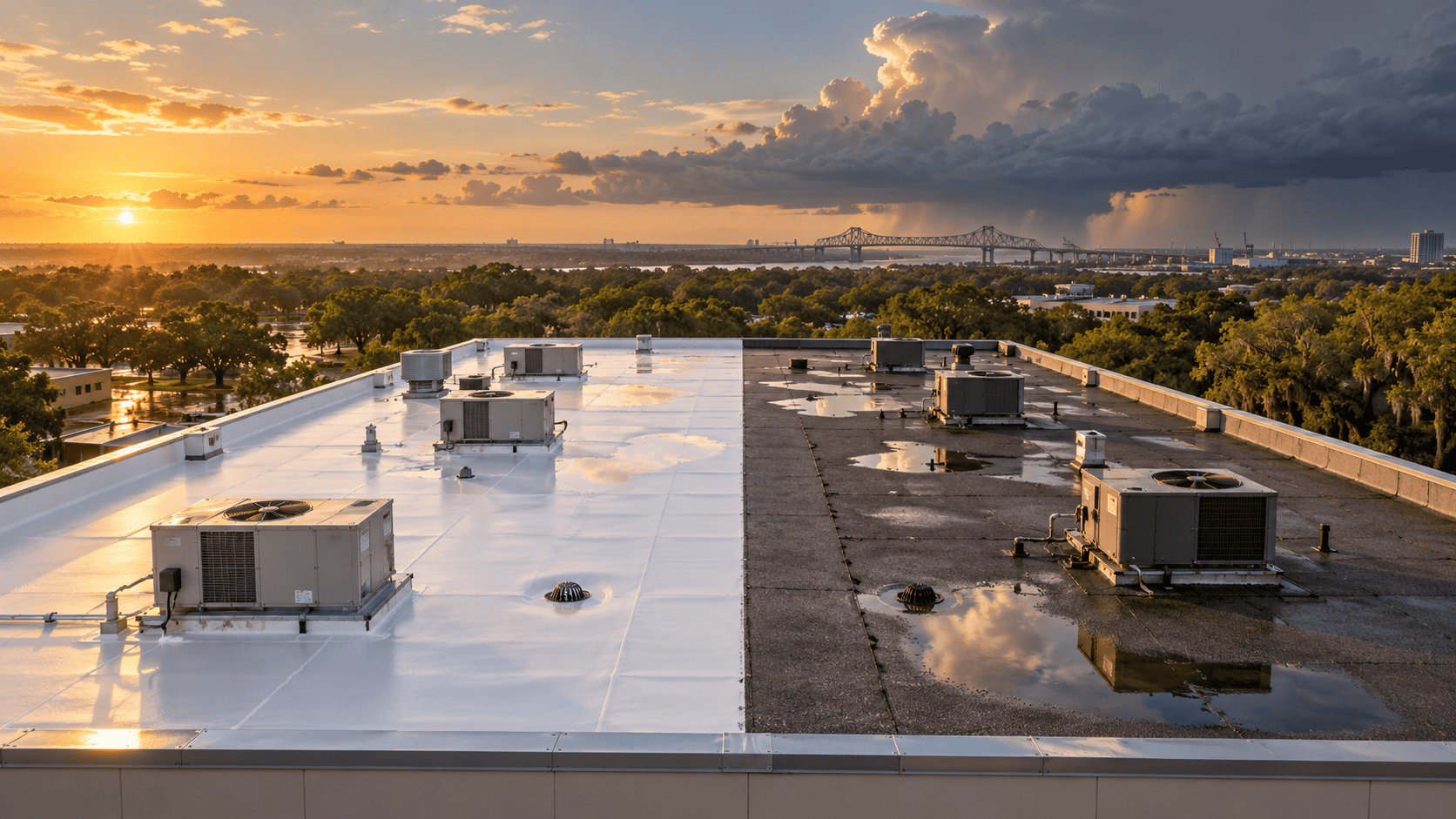
TPO is popular on warehouses, retail centers, offices and other large, open roofs. Its bright white surface reflects much of the sun’s heat, which can help keep the space below cooler during long Louisiana summers.
The membrane comes in different thicknesses, commonly 45, 60 and 80 mil. Thicker membranes cost more but give more protection against punctures and wear, which matters on roofs with HVAC units and regular service visits.
What is a modified bitumen roof?
Modified bitumen (often called “mod bit”) is an asphalt-based roofing system reinforced with polyester or fiberglass and blended with rubber or plastic modifiers. It is the modern descendant of traditional built-up tar-and-gravel roofs.
Unlike TPO, mod bit is usually installed in two or more layers: a base sheet and a granule-surfaced cap sheet on top. Those stacked layers give it a thick, tough surface. It can be torch-applied, set in cold adhesive, or installed as self-adhering sheets, depending on the building and the job conditions.
You will often find mod bit on restaurants, churches, small commercial buildings, older properties and roofs with a lot of equipment and foot traffic. Standard cap sheets are dark, but reflective white cap sheets and coatings are available to cut heat gain.
TPO vs. modified bitumen at a glance
In short, TPO wins on heat reflection and upfront cost for large roofs, while modified bitumen wins on toughness and puncture resistance.
| Factor | TPO | Modified bitumen |
|---|---|---|
| Material | Single-ply thermoplastic membrane | Multi-ply asphalt sheets with reinforcement |
| Layers | One | Usually two or more |
| Seams | Heat-welded | Torched, cold-adhered or self-adhered laps |
| Standard color | White (reflective) | Dark granules; white cap sheets available |
| Heat reflection | High | Lower unless coated or white-capped |
| Puncture and foot-traffic resistance | Good; better with thicker membranes | Very good |
| Upfront cost | Generally lower on large, open roofs | Generally higher due to extra layers |
| Repairs | Needs heat-welding equipment and a trained crew | Patched more easily with compatible materials |
| Best fit | Large, open roofs; buildings with high cooling loads | Smaller roofs; heavy equipment or foot traffic |
How each system handles Louisiana weather
Heat and sun
TPO has the edge here. Its white surface reflects sunlight instead of absorbing it, which keeps the roof surface cooler and can lower cooling costs inside. Dark mod bit absorbs heat, so on a building where AC costs are a big concern, ask for a reflective cap sheet or a coating.
Heavy rain and ponding water
Ponding water is the biggest threat to any Louisiana flat roof. Water that sits for more than 48 hours after a storm adds weight, breaks down materials and finds any weak seam.
Both systems can handle ponding when they are designed and installed correctly. Heat-welded TPO seams are very strong when done right, but a poorly welded seam is a common leak source. Mod bit’s multiple layers give a backup if the top layer is damaged. Neither material fixes a drainage problem, so tapered insulation, clear drains and working scuppers matter as much as the membrane.
Wind and storms
Both systems can be built to strong wind-uplift ratings. What matters most is the attachment method, the edge metal and the quality of the installation. Many wind failures start at the roof edge, where flashing and edge metal hold the membrane down. Custom-fabricated edge metal and flashing help keep the system sealed when storms roll through.
Humidity and moisture
Trapped moisture under any flat roof leads to rotted decking, wet insulation and mold. Good flashing details around HVAC curbs, pipes and walls are critical with either system. Regular inspections catch small openings before Louisiana humidity turns them into bigger problems.
Which one is right for your building?
TPO is usually the better fit if:
- Your roof is large and open, like a warehouse, big-box store or distribution center
- Cooling costs are a major expense and you want a reflective surface
- The roof sees limited foot traffic outside routine service visits
- You want a lower upfront cost per square foot on a big area
Modified bitumen is usually the better fit if:
- The roof has a lot of HVAC equipment, kitchen exhaust or regular foot traffic, as on restaurants and medical offices
- The roof is small or has many penetrations and odd shapes
- You are replacing an older built-up or mod bit roof and want a similar system
- You want a thick, multi-layer surface that resists punctures
Some buildings benefit from both, with mod bit or walkway pads in high-traffic areas around equipment and a reflective surface elsewhere. A roof inspection is the best way to see which approach suits your building’s drainage, structure and use.
Keeping either system in good shape
The membrane you choose matters less than how well it is maintained. A few habits add years to any Louisiana flat roof:
- Inspect twice a year and after major storms. Spring and fall inspections catch seam, flashing and drainage issues before they leak.
- Keep drains, gutters and scuppers clear. Leaves, pine needles and debris block drainage fast in the fall, which leads to ponding.
- Watch for ponding. Water still standing two days after rain points to a drainage or slope problem worth fixing early.
- Limit foot traffic. Add walkway pads along service routes so HVAC technicians are not wearing down the membrane.
- Check flashing around equipment. Curbs, pipes and wall transitions are where most flat roof leaks begin.
- Fix small problems quickly. A loose seam or small puncture is an easy repair; left alone, it can soak insulation and damage the deck.
A scheduled commercial roof maintenance plan takes these tasks off your plate and keeps a record of the roof’s condition over time.
Frequently asked questions
How long does a TPO or modified bitumen roof last in Louisiana?
Both systems commonly last about 20 years or more with good installation and regular maintenance. Heat, UV exposure, ponding water and foot traffic all shorten that. Twice-yearly inspections and prompt repairs make the biggest difference.
Can a new TPO roof go over my existing flat roof?
Sometimes. It depends on how many roof layers are already there, whether the existing insulation and deck are dry, and local code. Wet insulation trapped under a new roof will cause problems, so a core sample or moisture survey should come first.
Is a white roof always better in Louisiana?
A reflective roof helps most on buildings with high cooling costs and large roof areas. On a small roof with heavy foot traffic, durability may matter more than reflectivity. A white mod bit cap sheet or coating can give you some of both.
Why does my flat roof hold water after it rains?
Usually because of clogged drains, sagging decking, settled insulation or a roof that was built without enough slope. Tapered insulation and added drains or scuppers can fix most ponding problems during a repair or replacement.
Can flat roofs be repaired, or do they need full replacement?
Many flat roof leaks can be repaired, especially when the problem is a single seam, a puncture or one flashing detail. Replacement makes more sense when the insulation is widely saturated, the deck is damaged or the membrane is failing across the roof.
The bottom line
There is no single winner. TPO suits large, open roofs where heat reflection and upfront cost matter most. Modified bitumen suits busy roofs with lots of equipment and foot traffic. Whichever you choose, drainage, flashing and installation quality decide how long it lasts in Louisiana.
Premier South Roofing & Sheet Metal installs and repairs both systems for businesses across Baton Rouge, Lafayette, Covington, New Orleans and surrounding areas. Our in-house crews and on-site metal fabrication mean custom edge metal and flashing are built for your building. Learn more about our Baton Rouge flat roofing and New Orleans flat roofing services, or schedule a commercial roof inspection to find the right system for your property.